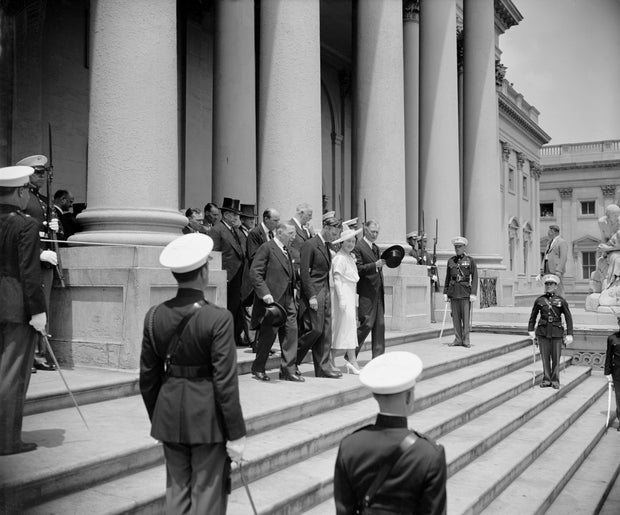
Photographs of British royals on American soil do more than capture moments—they document the evolving relationship between two nations tied by language, history, and diplomacy. As King Charles III embarks on his first state visit to the United States, images from past royal tours resurface, revealing a visual chronology of goodwill, soft power, and the enduring symbolism of monarchy in a republic.
These visits are never merely ceremonial. Behind the handshakes, parades, and state dinners lie strategic diplomatic overtures, cultural exchanges, and, often, efforts to reinforce transatlantic unity during turbulent times. The photographs—whether of a young Queen Elizabeth laying a wreath at Arlington or Prince Harry meeting veterans in New York—serve as enduring markers of those efforts.
This article traces the visual narrative of British royal visits to the U.S., using iconic images to illuminate both the personal and political dimensions of these trips, culminating in Charles III’s current state engagement.
The First Windsors in America: Edward VIII and the Diplomatic Debut
Long before Buckingham Palace became a global brand, royal travel was rare and politically sensitive. That changed with Edward, Prince of Wales—later Edward VIII—whose 1919 tour of North America marked a turning point. At just 24, he became the first senior royal to visit the U.S. after World War I.
Photographs from that trip show a dashing young prince in military uniform, standing beside U.S. soldiers and factory workers. In one widely circulated image, he’s seen pinning medals on American doughboys in Washington, D.C., a gesture meant to honor the alliance that won the war. These weren’t just PR moments; they were carefully choreographed signals of gratitude and solidarity.
But his most controversial visit came in 1939, just months before his abdication. Then the Duke of Windsor, he toured the U.S. with his new wife, Wallis Simpson. Photos of the pair at high-society events in New York and California sparked debate—less for their glamour than for the political unease surrounding his perceived Nazi sympathies. The imagery from that trip remains ambiguous: elegant, yet shadowed by controversy.
Edward’s visits set a precedent: royal presence in the U.S. could amplify diplomatic messaging, but missteps could damage both reputation and relations.
Queen Elizabeth II: The Crown’s Constancy in the American Consciousness
No royal shaped the visual narrative of the monarchy in America more than Queen Elizabeth II. Over seven decades, her visits generated some of the most enduring images in Anglo-American diplomacy.
Her first official U.S. visit came in 1957, just five years into her reign. A photograph from that trip—Elizabeth addressing a joint session of Congress in the Capitol Rotunda—became iconic. Dressed in a pale blue gown and regal jewels, she stood before a sea of American lawmakers, the first British monarch ever to do so. The image symbolized postwar unity and the special relationship at its peak.
That same year, she visited President Eisenhower at the White House. One candid shot shows them laughing on the Truman Balcony, a moment of unscripted warmth that humanized both leaders. The contrast was striking: a youthful president and a young queen, steering their nations through the Cold War with a blend of formality and friendship.
:max_bytes(150000):strip_icc():focal(728x275:730x277)/princess-catherine-prince-william-donald-trump-king-charles-iii-trump-state-visit-uk-windsor-091725-8672599a27214b6f8ffdbb07fd7596e4.jpg)
Later visits reinforced her stature. In 1976, during the U.S. Bicentennial, she toured Boston, Philadelphia, and New York. Images of her standing beside Revolutionary War reenactors—or smiling as she rode through New York City in an open-top carriage—struck a delicate balance between historical respect and modern camaraderie.
By the time of her 2007 visit for the 400th anniversary of Jamestown, her presence had become a reassuring constant. A photo of her shaking hands with President George W. Bush outside the White House, flags fluttering behind them, felt less like diplomacy and more like tradition.
Elizabeth’s ability to project stability, continuity, and approachability—captured in thousands of photos—cemented her as the most recognizable and respected British figure in American public life.
Prince Charles: From Young Diplomat to King in Waiting Before he was king, Charles made numerous trips to the U.S., each contributing to a more complex, and sometimes controversial, public image.
His first solo U.S. visit came in 1970, when he toured NASA facilities and met with President Nixon. Photos from that trip show a serious, somewhat stiff young man in a suit, peering into space capsules. The imagery emphasized his role as a representative of national prestige—not just Britain’s, but the broader Commonwealth.
Throughout the 1980s and ’90s, Charles and Diana became a global phenomenon. Their 1985 visit to the White House—where they danced at a state dinner hosted by Ronald Reagan—produced one of the most iconic royal images in American memory. Diana in her midnight-blue velvet gown, gliding across the floor with Charles, became a symbol of glamour and youth. But behind the photo, tensions were already mounting, later revealed in their very public separation.
Later trips, especially after Diana’s death, shifted tone. Charles began focusing on causes: climate change, urban planning, and youth empowerment. A 2011 photo of him visiting a Harlem charter school—kneeling to speak with students—reflected a more engaged, issue-driven approach. These images helped rehabilitate his image, portraying him not just as heir, but as an advocate.
Now, as King Charles III, his state visit is being framed not as a nostalgia tour, but as a continuation of this mission. Early photos from his 2023 trip—meeting with President Biden, touring a clean energy facility in Philadelphia—signal a monarch modernized, focused on global challenges rather than ceremonial display.
The William and Harry Era: Royalty in the Age of Social Media When Prince William and Prince Harry began representing the monarchy in the U.S., the context had changed. Cameras were everywhere, and public expectations had shifted. Their visits were no longer just for newsreels—they were for Instagram, Twitter, and viral videos.
William’s 2011 trip with Kate, months after their wedding, was a masterclass in modern royal diplomacy. Photos of them walking hand-in-hand through Central Park, waving from a boat on the Potomac, or toasting at a New York gala combined tradition with accessibility. One image—Kate in a red dress at a Lincoln Center dinner—became a fashion moment, widely shared online.
:max_bytes(150000):strip_icc():focal(749x0:751x2)/king-charles-III-state-visit-of-the-president-of-the-republic-of-south-africa-112222-4-806910a78d3444cf87ef8dcb828390e0.jpg)
Harry’s visits carried deeper emotional weight. His 2013 trip to the Invictus Games—founded to support wounded veterans—produced some of the most powerful images of his career. A photo of him hugging a U.S. Marine at a training facility in Florida radiated authenticity. These were not just royal appearances; they were personal missions.
But the optics grew complicated after Harry and Meghan stepped back from royal duties. Photos of Harry in California, speaking at events or attending celebrity functions, contrasted sharply with images of William on official tours. The visual split underscored a deeper rift—not just within the family, but in how modern monarchy is perceived in America.
What Royal Photos Reveal About Public Perception
Photographs of royal visits do more than document events—they shape how the monarchy is understood. A single image can define a narrative: Elizabeth as dignified, Charles as earnest, Harry as empathetic, William as steady.
But they can also mislead. A smile at a parade doesn’t reveal diplomatic tensions. A warm handshake may mask policy disagreements. The curated nature of royal photo ops means that what we see is often a polished version of reality.
Yet, in the U.S., where the monarchy is neither political nor obligatory, these images matter. Americans don’t answer to the king, but they are influenced by how he appears. A relatable photo can boost sympathy; a tone-deaf one can fuel criticism.
Consider King Charles III’s 2023 visit. Early images showed him at a Philadelphia community garden, speaking with local growers. The message was clear: a king connected to people, not palaces. But when photos emerged of lavish state dinners and motorcades, some media outlets questioned the cost and relevance.
The takeaway? In the age of digital scrutiny, every photo is a statement—and every statement is dissected.
The Symbolism of a State Visit in a Republic
Why do state visits still matter in a country without a king?
Because they are not about monarchy per se, but about diplomacy wrapped in symbolism. A British monarch visiting the U.S. president is a rare convergence of historical weight and contemporary alliance.
The photos from these visits become part of the national memory. They’re used in textbooks, news retrospectives, and political commentary. They remind Americans of shared values, even when governments disagree.
And for the monarchy, these trips are vital for relevance. In an increasingly skeptical world, visibility in a major democracy like the U.S. reinforces the institution’s global role.
King Charles III’s visit, arriving amid climate crises, democratic backsliding, and strained international relations, carries added weight. The images from this trip—whether he’s speaking at a university, honoring veterans, or touring a tech incubator—will be studied not just for their content, but for their subtext.
Conclusion: The Power of the Image in Diplomacy
As King Charles III walks through Washington, D.C., flanked by U.S. officials and waving to crowds, cameras will capture every moment. Those photos will join a century-long archive of royal presence in America—a visual record of friendship, evolution, and the careful dance between tradition and modernity.
The monarchy doesn’t govern America. But through photographs, it continues to influence how millions see Britain, its history, and its place in the world. For Charles, the challenge is not just to uphold that legacy, but to redefine it for a new era.
For the public, the lesson is clear: look beyond the crown, the uniform, the smile. In every royal photo, there’s a story—not just of a visit, but of a relationship in motion.
Frequently Asked Questions
Why are royal visits to the U.S. considered state visits? State visits are formal invitations extended by the president to foreign heads of state. While the British monarch is not a head of government, they are recognized as a head of state, making such trips official state engagements.
How often have British monarchs visited the U.S.? Queen Elizabeth II visited the U.S. multiple times—officially in 1957, 1959, 1976, 1981, 1985, 1991, and 2007. King Charles III made his first state visit in 2023.
Who covers the cost of a royal state visit? Costs are typically shared. The host country (U.S.) covers security, transportation, and official events, while the visiting delegation handles personal staff and some accommodations.
Are royal visits politically significant? Yes. While ceremonial, they reinforce diplomatic ties, support trade discussions, and signal alliance strength, especially during global crises.
How do royal visits impact public opinion in the U.S.? Positive imagery can boost favorability toward the monarchy and the U.K. Conversely, controversies or perceived extravagance can lead to criticism.
What role do photos play in shaping the visit’s legacy? Photos are primary historical records. They influence media coverage, public perception, and long-term memory of the visit more than speeches or policy talks.
Has any royal visit led to major policy changes? Not directly, but they create environments conducive to diplomacy. For example, Elizabeth’s 1991 visit during the Gulf War reinforced U.S.-U.K. military coordination.
FAQ
What should you look for in Royal Visits to America: A Photographic Legacy? Focus on relevance, practical value, and how well the solution matches real user intent.
Is Royal Visits to America: A Photographic Legacy suitable for beginners? That depends on the workflow, but a clear step-by-step approach usually makes it easier to start.
How do you compare options around Royal Visits to America: A Photographic Legacy? Compare features, trust signals, limitations, pricing, and ease of implementation.
What mistakes should you avoid? Avoid generic choices, weak validation, and decisions based only on marketing claims.
What is the next best step? Shortlist the most relevant options, validate them quickly, and refine from real-world results.